UX Writing & Copywriting
Clear, speakable content for voice and multimodal products, from first prompt to final handoff.
I'm a conversational content designer with about five years of experience writing for voice and multimodal products. Much of that work is UX writing: prompts people can answer out loud, instructions that work by ear, recovery messages, confirmations, and handoffs to SMS and screens. I also write brand voices and characters that stay clear when heard once.
These examples span travel, product discovery, and playful brand experiences, on Alexa, on screen, and by text.
Writing for voice: what changes
I apply the same UX writing principles you'd use on a website or in an app: clarity, one next step, honest expectations, helpful errors. Voice adds constraints that screens don't have.
No scrolling back. Listeners hear a choice once. Options need to be short, distinct, and easy to remember.
People have to say the words. The answer has to be easy to pronounce and easy for the system to recognize, so wording is part of the interface.
Time is part of the copy. Pauses, pacing, and transitions decide whether people can follow along or join in.
One experience, several surfaces. Sound, screen, and phone work together. Copy has to tell people when and where to look next, for example "Check your texts."
Brand voice is performed. Characters and celebrities deliver the lines, so rhythm and phrasing matter as much as word choice.
Written for more than one market. I shipped German and Italian experiences, working with translators who localized the scripts.
Audio ads: from listening to interacting
I also wrote audio ads and calls to action that led listeners into interactive Alexa experiences, which add a different constraint: a single listen, with no chance to interact. The closing line had two jobs: give people a reason to participate, and tell them exactly what to say. The launch phrase had to be easy to understand when heard once, easy to repeat, and consistent with the experience that followed.
Honda Pilot · 30-second audio ad
Mud, snow, or sand, it can handle any situation. But can you? To test your wilderness survival knowledge, and see how long you'd last, just say "Alexa, open the Honda Pilot Challenge." That's, "Alexa, open the Honda Pilot Challenge," now.
Writing decision: The ad builds the reason to participate before it gives the instruction. "But can you?" turns a product claim into a challenge, and the launch phrase comes last and is repeated, so listeners can say it back accurately.
See all audio ads: Nature Valley, Propel, Ford
Writing for generative AI
In AI-agent experiences, I write instructions that guide responses across different requests and contexts, rather than scripting every exchange.
I assess how agents respond, checking clarity, relevance, tone, and adherence to instructions. I use those findings to refine prompts and retest the interactions.
Tripadvisor: Helping travelers decide what to explore

Role: Destination content and UX copy, including sponsored guides with Holiday Inn and Visa
Challenge: Choices had to be clear on first hearing, with a natural handoff to the phone
Worked with: Designers, developers, Tripadvisor and sponsor stakeholders
I wrote destination content and UX copy for Tripadvisor's interactive travel guides on Alexa. The guides combined destination inspiration, practical information, and clear choices, then helped travelers continue on their phones. Travelers heard the content and answered aloud, so every choice had to be understandable on first hearing, easy to remember, and easy to say.
UX writing
Turning a broad destination into three choices
Original dialogue · Los Angeles
Guide: So where would you like to explore first? Hidden gems, local cuisine, or must-sees? Traveler:Hidden gems. [Destination recommendations omitted] Guide: Would you like to see more from Los Angeles? You can discover more by choosing between must-sees or local cuisine.
Writing decision: A whole city is too much to choose from by ear, so the opening offers three starting points. The follow-up offers only the categories not yet heard, and naming the options also tells travelers what they can say.
Removing a turn between travelers and their next choice
Across other travel-guide experiences, I refined follow-up prompts to offer the remaining topics directly.
Reconstructed example of an implemented refinement.
Earlier pattern Guide: Would you like to explore further? Traveler: Yes. Guide: What would you like to hear more about? Must-sees, unexpected experiences, or helpful facts?
Refined pattern, after exploring must-sees Guide: What would you like to explore next: unexpected experiences or helpful facts?
Writing decision: The yes/no question added a turn without adding a decision. Moving the real choice into the follow-up gets travelers to what they want faster.
Offering a way to continue on the phone
Original dialogue · Abu Dhabi
Guide: Would you like to explore further? Traveler: No. Guide: All right. Would you like me to send you a link so you can discover more about Abu Dhabi? Traveler: Yes.
Writing decision: Declining more spoken content is not the same as being done with the destination. The dialogue separates the two, and the invitation says what the link is for before the experience asks for a phone number.
A further refinement. After two categories, the next prompt could offer the remaining topic alongside the link:
Guide: Would you like to hear some helpful facts, or get a link to explore Abu Dhabi on Tripadvisor?
This lets travelers choose between more spoken content and continuing on their phone, and it explains the link's destination before asking for contact details.
Proposed extension of the refinement, not original production dialogue.
Copywriting
Adapting one structure to different destinations
The guides shared a recognizable framework while the copy reflected each place and each traveler's interests.
Writing decision: Each line gives a different reason to go: atmosphere, family appeal, and easy transport. The consistent structure leaves room for local detail and connects the accommodation with the surrounding destination.
Bringing traveler perspectives into destination content
Original script excerpt · Abu Dhabi
Guide: Explore the mangrove by taking a stroll on a meandering boardwalk, or get close up on a kayak and see if you can spot bird and marine species unique to Abu Dhabi. Review summary: Tripadvisor travelers frequently mention the lovely walk and beautiful natural setting, citing that they'll definitely be back for another visit.
Writing decision: The description helps travelers picture the activity. The review summary then adds a traveler's perspective, kept distinct from the guide's own narration, so listeners get a second way to judge the experience.
Introducing the sponsor before the recommendations
Original copy · Milan, sponsored by Visa
"This travel experience is brought to you by TripAdvisor in partnership with Visa." [Shopping recommendation omitted] "What's even better, you get 5% off your purchases when you use your Visa card."
Writing decision: Travelers should know about the partnership before they hear any recommendation. The offer then appears at the one moment it is relevant, inside the shopping section, instead of reading as a separate ad.
Capri Sun: Clear guidance through play
Role: Activity scripts, prompts, and recovery copy
Challenge: Families had to understand instructions by ear and say theme names aloud
Worked with: Designers, developers, brand team
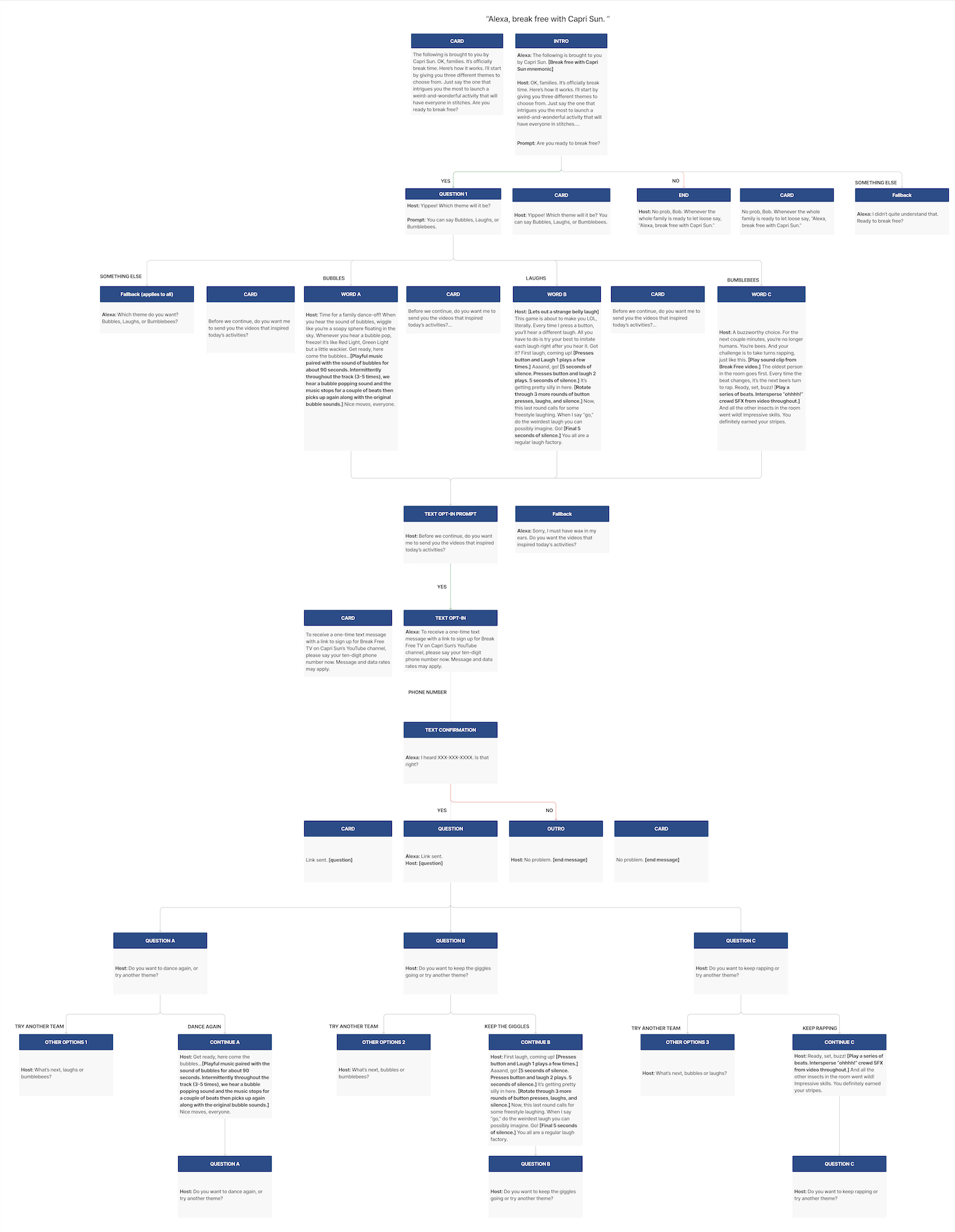
I wrote activity scripts and UX copy for a Capri Sun family game on Alexa, supported by on-screen gameplay. Families chose between dancing, laugh imitation, and a bee-themed rap. The writing combined a playful brand voice with clear instructions, recovery prompts, and contextual choices, while sound and screen helped families understand what to do.
UX writing
Making the first choice easy to answer
Host: Yippee! Which theme will it be? You can say Bubbles, Laughs, or Bumblebees.
Writing decision: The invitation and the possible answers are separate sentences. "You can say" gives families the exact words to use, and the short theme names set the playful tone.
Helping families recover
Alexa: Which theme do you want? Bubbles, Laughs, or Bumblebees?
Writing decision: When a response doesn't match a theme, families need what they require to try again, right away. The recovery prompt repeats the options so nobody has to remember them from an earlier turn.
Making the next step specific to the activity
Writing decision: A generic "play again?" would work, but naming the activity confirms what just happened and makes the choice concrete. The structure stays the same across themes while the wording changes.
Exploring clearer theme descriptions
Original: "You can say Bubbles, Laughs, or Bumblebees." Proposed: "Choose Bubbles for dancing, Laughs for silly laughs, or Bumblebees for rapping. Which theme will it be?"
Writing rationale: The theme names create curiosity but don't explain the activities. The revision pairs each theme with its activity and keeps the original response labels, but it adds listening time. I'd evaluate whether families understand the options and pick a theme without needing another explanation.
Portfolio refinement based on the original script. Not tested or shipped.
Copywriting
Turning instructions into action
Host: Time for a family dance-off! When you hear the sound of bubbles, wiggle like you're a soapy sphere floating in the sky. Whenever you hear a bubble pop, freeze! It's like Red Light, Green Light but a little wackier. Get ready, here come the bubbles… [Music and bubble sounds accompany the activity. A popping sound signals when to freeze.] Host: Nice moves, everyone.
Writing decision: Each sound is tied to one action: bubbles mean move, a pop means freeze. The Red Light, Green Light reference explains the mechanic in a few words, and the imagery keeps the directions fun.
Writing for participation and pacing
Host: First laugh, coming up! [A recorded laugh plays.] Host: Aaaand, go! [Five seconds of silence for participants to imitate the laugh.]
Writing decision: In a participation game, silence is part of the script. "Aaaand, go!" marks the handoff from listening to joining in, and the pause gives families room to respond instead of filling every moment with narration.
Propel: From motivation to action
Role: Dialogue and UX copy
Challenge: Keep a celebrity's personal tone distinct from Alexa's functional prompts, and make the shopping action explicit
Worked with: Designers, developers, brand team
I wrote dialogue and UX copy for a Propel experience featuring Michael B. Jordan and Alexa. It combined workout motivation with opportunities to explore and shop Propel products.
UX writing
Making the shopping action explicit
Michael: Whenever I want refreshing hydration, I reach for a Propel. Alexa: Would you like to add a six-pack of Berry Propel to your Amazon Shopping Cart? After acceptance Alexa: OK, I've added that item to your cart.
Writing decision: The prompt names the quantity, flavor, product, and destination. "Add" makes clear that this puts something in the cart rather than completing a purchase, and the confirmation states exactly what happened.
Aligning the voice invitation with the text message
Writing rationale: The original invitation promised "more information" and the SMS then asked people to shop. The revision describes the same activity in both places and names the destination. That matters at a device handoff, where the message on the phone should match what the person agreed to hear on the speaker.
Copywriting
Making motivation feel approachable
Michael: Hey, it's Michael B. Jordan. I hear you're looking for a little motivation? Well, you're not alone. Everyone struggles with finding a way to reach their goals sometimes. Alexa: Except for you, right?Michael: Actually, Alexa, I look for motivation all the time. But there are a few tricks that I use to help me push through the most challenging moments in my workout. So, in the spirit of Creed III, let's get straight to the punch. You ready to hear the top three things that keep me going?
Writing decision: Alexa's line voices the listener's assumption that motivation comes easily to Michael, and his answer makes him relatable. "The top three things" sets an expectation for what's ahead, and the Creed III reference ties the invitation to the campaign.
Giving each voice a purpose
Michael: Another thing that keeps me going is music. I've got a handful of go-to workout playlists with tracks that just fire me up. And I know exactly which songs to play when I'm hitting a wall. Alexa: Can't beat a good beat. Michael: Badum-ch! Want to hear my last tip for staying motivated?
Writing decision: Michael delivers the personal advice in longer passages. Alexa adds a short reaction that breaks them up, then Michael's closing question signals that the sequence is nearly over.
Cheetos: Bringing character to recipe discovery
Role: Dialogue and UX copy
Challenge: Keep a strong character voice while making every question easy to answer
Worked with: Designers, developers, brand team
I wrote dialogue and UX copy for a Cheetos cooking experience featuring Chef Chester Cheetah. It helped people choose a recipe, receive it by text, and explore the Cheetos Duster. The script was performed through voice with sound effects, so the writing had to balance character performance with useful guidance.
UX writing
Narrowing a recommendation through two easy choices
Chef Chester: Dust Yeah! It's time to treat yourself, and your family and friends too, I guess. Guide: Are you cooking a snack or a whole meal? Participant: Snack. Chef Chester: Cheese-tastic. And what about the flavor? Guide: Are you in the mood for something cheesy or spicy? Participant: Cheesy.
Writing decision: Two concrete questions, occasion and then flavor, lead to a recommendation. The character reacts and a neutral guide asks, so the options stay easy to pick out without losing Chester's voice.
Handing off to the phone
Guide: Would you like Chef Chester Cheetah to text you a link to the full recipe? Participant: Yes. [Phone-number collection and confirmation omitted] Guide: Link sent. Check your texts.
Writing decision: The invitation names the delivery method and what the person will receive. The confirmation says the action is done and tells them where to look next.
Closing after a declined purchase
Guide: Would you like to add the Cheetos Duster to cart? Participant: No. Chef Chester: Okay, then. That's my show. I loved sharing my recipes with you because sharing is caring, except when it comes to your Cheetos snacks. I hope you enjoy the chee-licious meals.
Writing decision: The experience accepts the "no" without repeating the sales question and moves straight into the close. Chester's last joke keeps the character in place until the end.
Copywriting
Building personality beyond wordplay
"It's time to treat yourself, and your family and friends too, I guess." "Sharing is caring, except when it comes to your Cheetos snacks."
Writing decision: Chester's reluctant generosity gives him a point of view. The humor comes from his attitude as well as the cheese puns, so he sounds like a character rather than a collection of slogans.
Connecting preferences to a recommendation
Chef Chester: My Purr-fect Popcorn Balls are a delicious sweet treat for when you want a dangerously cheesy snack, stat. All you need is some Cheetos Cheddar Popcorn, Cheetos crunchy snacks, mini marshmallows, caramel bits, and freshly dusted Cheetle.
Writing decision: The recommendation echoes the participant's earlier choice of a cheesy snack, and the short ingredient list lets them picture the recipe before deciding whether to request the full version.
Milk-Bone: Bringing "More Dog" to life
Role: Creative scripts and UX copy
Challenge: Give each activity its own creative hook inside one affectionate voice
Worked with: Designers, developers, brand team
I wrote creative scripts and UX copy for Milk-Bone's "More Dog" experience on Alexa, with supporting on-screen content and app cards. The activities ranged from dog nicknames and quizzes to an imagined canine inner monologue, and each one needed its own hook while feeling part of the same dog-obsessed world.

UX writing
Anticipating a missing answer
"Don't know their birthday? Their gotcha day will do."
Writing decision: The astrology activity needs the dog's zodiac sign, and many people don't know their pet's birthday. The line offers an alternative before the problem arises, in the same warm voice, so there's no separate recovery exchange.
Keeping feedback clear and playful
Quiz prompt: "Alright, it's guessing time. Which breed did Milk-Bone feed? You can say, 'bulldog,' 'frenchie,' or 'german shepherd.'" Correct-answer feedback: "That's correct! Congrats, your listening skills are a breed apart."
Writing decision: The question names the possible responses. The feedback confirms the result first and adds the wordplay second, so the outcome is clear before the personality arrives.
Bridging from the activity to the product
After the nickname activity: "Want to meet the treat that inspired it?"
Writing decision: The invitation points back to the nickname the person just received. It introduces the product in the activity's own language, so the commercial step feels like a continuation.
Copywriting
Creating a recognizable verbal identity
"More dog-ductive reasoning." "Ready for a quick pup-quiz?" "Ready, set, chew!"
Writing decision: The dog theme carries through the activity name, the invitation, and the transition. Each line also does a different job: it introduces the concept, invites participation, and signals the start.
Reflecting how people talk about their dogs
"More dog nicknames! Because there's no such thing as too many things to call your boopy lil' squishface. Am I right? Just answer two quick questions about your dog to get a nickname inspired by Milk-Bone that you can add to your evergrowing list."
Writing decision: The affectionate language mirrors the silly names people really use for their pets. "Two quick questions" then sets a clear expectation, linking the creative introduction to the task.
Building character through rhythm
"I will pass this test. I will be still and get a treat. Oh no, I got distracted. Okay, I will be still. Very still. Treat. Still. Wait, what's that over there? No, focus. Be still. Treat. Treats. Lots of treats."
Writing decision: Short sentences, repetition, and sudden shifts of attention create the dog's voice. Written for spoken delivery, the passage gives the performer a rhythm that moves between determination and distraction.
Crypto tax: Making the next step clear
Role: Independent copywriting and UX writing exercise
Challenge: Explain a technical product in plain language without implying the tool removes the need to review the data
Status: Concept work, not shipped
I developed landing-page, onboarding, and feature messaging for a fictional crypto-tax tool. The audience is people who already invest across wallets or exchanges and want less manual work preparing their tax information.
Connecting the benefit with the first action
Headline: Less time sorting transactions. More clarity at tax time.
Supporting copy: Bring your crypto transactions into one place, review missing information, and generate a tax report from your data.
Primary button: Create an account
Secondary link: See how it works
Supporting text: Start by connecting a wallet or exchange.
Writing decision: The headline focuses on reducing effort, and the supporting copy includes the review step so the benefit is honest. The button describes the immediate action instead of promising a finished report before any data has been added.
Making missing information actionable
Label: Acquisition cost missing
Explanation: We couldn't find what you originally paid for this asset. Add the cost to include it in the gain or loss calculation.
Button: Add acquisition cost
Writing decision: The message separates the issue, its consequence, and the action. It pairs the technical term with a plain-language explanation and avoids treating a missing value as zero.
Concept copy for a fictional product. Product capabilities are assumed for the exercise. Not tested or shipped.